中文

The strongest permanent magnet in commercial production — what the material is, why it is strong, and where it is used.
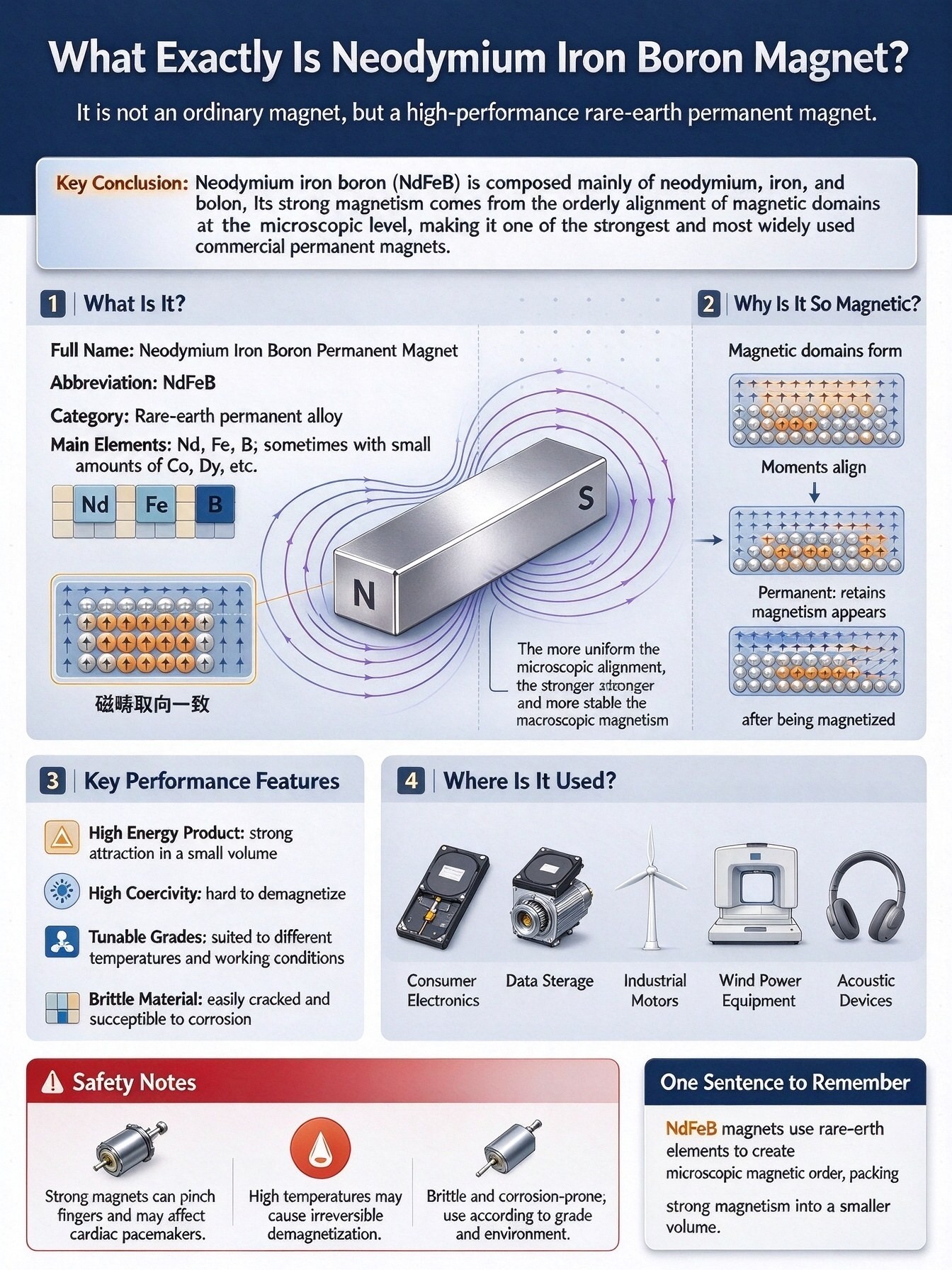
A neodymium magnet is not a lump of rare-earth metal. It is an intermetallic compound, Nd2Fe14B — about 30% neodymium, 65% iron and 1% boron — discovered in 1984 independently by General Motors and Sumitomo Special Metals. Iron supplies the magnetism; the neodymium lattice locks every magnetic moment in one direction. That combination is why a magnet the size of a coin can lift several kilograms.
Most magnets sold today are sintered: the alloy is strip-cast, jet-milled to a few microns, pressed in a magnetic field, sintered near 1,080 °C, then ground and coated. Bonded and hot-pressed grades trade strength for shape freedom. A code such as N42 or N48 states the maximum energy product; the letters after it — M, H, SH, UH, EH — state how hot the magnet can run before it demagnetises, from roughly 80 °C for plain N grades to beyond 180 °C for UH.
Heat is the real constraint. Because Nd2Fe14B loses coercivity quickly when warm, dysprosium and terbium are added — increasingly by grain-boundary diffusion instead of in the bulk alloy, which lowers cost and supply risk.
Applications follow from that mix of strength and temperature: traction motors, wind turbine generators, hard drives, phone speakers, MRI scanners and robotics. They also attract iron, are brittle, and lose their field above their rated temperature — so they are always designed, not simply picked.